
Publications
Zhu M; In preprints: re-examining the role of oxygen in mammalian embryogenesis. Development 1 April 2026; 153 (7): dev205661. doi: https://doi.org/10.1242/dev.205661
*** Zhu M, Catta-Preta R, LeeC, Tabin CJ┼. Shifts in embryonic oxygen levels cue heterochrony in limb initiation. Cell, 2026; https://www.cell.com/cell/fulltext/S0092-8674(26)01062-7
*** Zhu M, Meglicki M, Lamba A, Wang P, Royer C, Turner K, Jauhar MA, Jones C, Child T, Coward K, Na J, Zernicka-Goetz M. Tead4 and Tfap2c generate bipotency and a bistable switch in totipotent embryos to promote robust lineage diversification. Nat. Struct. Mol. Biol. 2024; 31(6): 964-976
***It has long been known that, at the earliest stages of mammalian development, embryonic and extra-embryonic lineages exhibit developmental plasticity, enabling cell fate transitions to compensate for the loss of adjacent cells. However, this plasticity is progressively lost as development proceeds. This study identifies a "composite state" mechanism as essential for the manifestation of such plasticity. I define the genetic factors that are both necessary and sufficient to establish this state and the developmental plasticity for fate switches. Furthermore, my previous and current findings together suggest that these factors also initiate cell polarity, which establishes a negative feedback loop that drives the timely resolution of the composite state and the loss of developmental plasticity. Overall, this study elucidates the regulatory mechanisms underpinning the establishment and resolution of developmental plasticity in mammalian embryos, and in the meantime providing additional genetic candidates for the derivation of totipotent cell lines.
- Lamba A*, Zhu M*, Meglicki M, Czukiewska S, Balasubramaniam L, Hadas R, Weishaupt N, Patel Ekta M, Kavanagh Yu H, Wang R, Jing N, Zernicka-Goetz M┼. Asynchronous mouse embryo polarization leads to heterogeneity in cell fate specification eLife. 2024 13:RP101140
- Zhu, M. and Tabin, C.J┼. The role of timing in the development and evolution of the limb. Frontiers in Cell and Developmental Biology, 2023 11, p.1135519.
*This review summaries of the variation of limb developmental timing during evolution and the variations in hindlimb development in mammals.
- Zhu M*, Shahbazi M*, Martin A*, Zhang C, Sozen B, Borsos M, Mandelbaum RS, Paulson RJ, Mole MA, Esbert M, Titus S, Scott RT, Campbell A, Fishel S, Gradinaru V, Zhao H, Wu K, Chen ZJ┼, Seli E┼, de Los Santos MJ┼, Zernicka Goetz M┼. Human embryo polarization requires PLC signaling to mediate trophectoderm specification. eLife. 2021 Sep 27;10:e65068. doi: 10.7554/eLife.65068.
*** Zhu M, Cornwall-Scoones J, Wang P, Handford CE, Na J, Thomson M, Zernicka-Goetz M┼. Developmental clock and mechanism of de novo polarization of the mouse embryo. Science. 2020 Dec 11;370(6522):eabd2703. doi: 10.1126/science.abd2703.
***Developmental timing is regulated by both cell-intrinsic and cell-extrinsic mechanisms. A well-established example of a cell-intrinsic developmental clock is the timing mechanism that governs de novo cell polarity establishment during mammalian embryo development. This polarity timing is programmed to occur at a species-specific interval following fertilisation and remains robust against perturbations in cell-cell contact or cell cycle progression. The onset of de novo cell polarity marks the loss of totipotency—the ability to give rise to all lineages—and initiates cell differentiation. This study identifies the genetic factors that are both necessary and sufficient for de novo polarity establishment, and elucidates the cellular mechanisms underlying its timing and robustness.
- Zhu M┼, Zernicka-Goetz M┼. Principles of Self-Organization of the Mammalian Embryo. Cell. 2020 Dec 10;183(6):1467-1478. doi: 10.1016/j.cell.2020.11.003.
- Zhu M, Zernicka-Goetz M┼. Living a Sweet Life: Glucose Instructs Cell Fate in the Mouse Embryo. Dev Cell. 2020 Apr 6;53(1):1-2. doi: 10.1016/j.devcel.2020.03.012.
- Zhu M, Zernicka-Goetz M┼. Building an apical domain in the early mouse embryo: Lessons, challenges and perspectives. Curr Opin Cell Biol. 2020 Feb;62:144-149. doi: 10.1016/j.ceb.2019.11.005. Epub 2019 Dec 21.
- Zhu M, Leung CY, Shahbazi MN, Zernicka-Goetz M┼. Actomyosin polarisation through PLC-PKC triggers symmetry breaking of the mouse embryo. Nature communications. 2017;8(1):921.
- Leung CY*, Zhu M*, Zernicka-Goetz M┼. Polarity in Cell-Fate Acquisition in the Early Mouse Embryo. Curr Top Dev Biol. 2016; 120:203-34.
-
- Atsuta Y, Lee C, Rodrigues AR, Colle C, Tomizawa RR, Lujan EG, Tschopp P, Galan L, Zhu M, Gorham JM, Vannier JP, Seidman CE, Seidman JG, Ros MA, Pourquié O, Tabin CJ. Direct reprogramming of non-limb fibroblasts to cells with properties of limb progenitors. Dev Cell. 2024 Feb 5;59(3):415-430.e8. PubMed Central PMCID: PMC10932627.
- Shen C*, Lamba A*, Zhu M, Zhang R, Zernicka-Goetz M┼, Yang C┼. Stain-free detection of embryo polarization using deep learning. Sci Rep. 2022 Feb 14;12(1):2404. doi: 10.1038/s41598-022-05990-6.
- Singla S, Iwamoto-Stohl LK, Zhu M, Zernicka-Goetz M┼. Autophagy-mediated apoptosis eliminates aneuploid cells in a mouse model of chromosome mosaicism. Nat Commun. 2020 Jun 11;11(1):2958. doi: 10.1038/s41467-020-16796-3.
- Amadei G, Lau KYC, De Jonghe J, Gantner CW, Sozen B, Chan C, Zhu M, Kyprianou C, Hollfelder F, Zernicka-Goetz M┼. Inducible Stem-Cell-Derived Embryos Capture Mouse Morphogenetic Events In Vitro. Dev Cell. 2021 Feb 8;56(3):366-382.e9. doi: 10.1016/j.devcel.2020.12.004. Epub 2020 Dec 29.
- Sozen B, Jorgensen V, Weatherbee BAT, Chen S, Zhu M, Zernicka-Goetz M┼. Reconstructing aspects of human embryogenesis with pluripotent stem cells. Nat Commun. 2021 Sep 21;12(1):5550. doi: 10.1038/s41467-021-25853-4. PMID: 34548496; PMCID: PMC8455697.
- Hupalowska A, Jedrusik A, Zhu M, Bedford MT, Glover DM, Zernicka-Goetz M┼. Inter-relationships of CARM1 and paraspeckles in regulating pre-implantation mouse embryo development. Cell.2018; 175:1902-1916 e1913.
- Shahbazi MN, Scialdone A, Skorupska N, Weberling A, Recher G, Zhu M, et al. Pluripotent state transitions coordinate morphogenesis in mouse and human embryos. Nature. 2017;552(7684):239-43.
* Equal contribution, ┼Corresponding author
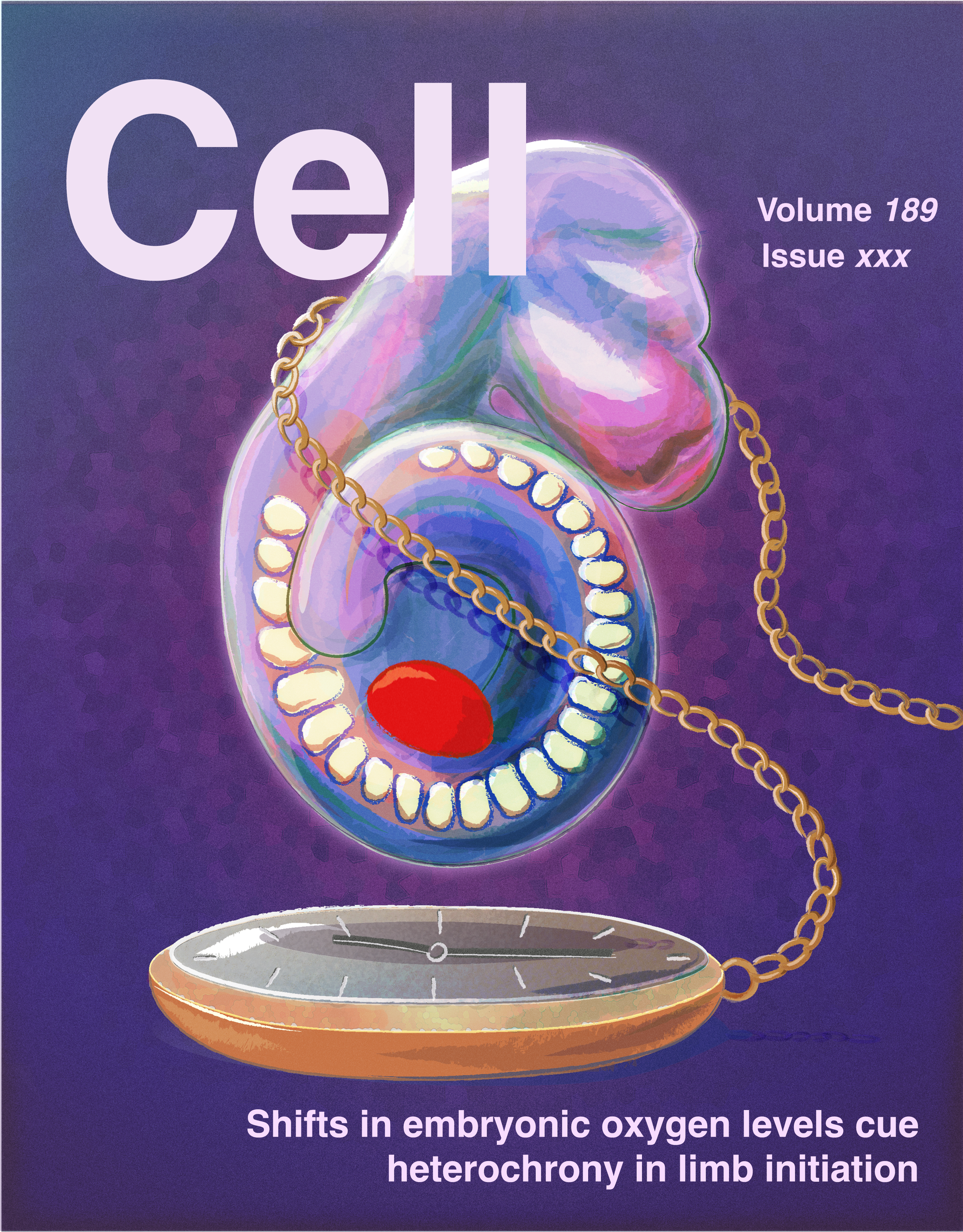
**Limb development in amniotes exhibits species-specific temporal variation, an example of heterochrony with important evolutionary and physiological implications. While the differential timing of forelimb and hindlimb initiation has long been recognised, the underlying mechanisms and adaptive advantages remain poorly understood. A prevailing hypothesis posits that mammals employ an energy trade-off strategy, delaying hindlimb development to optimise resource allocation during early embryogenesis when nutrient supply is limited. This work identifies maternal hypoxia as a key environmental cue that selectively halts hindlimb initiation in early mammalian embryos, thereby establishing limb heterochrony. These findings uncover an unappreciated role of oxygen availability in regulating developmental timing and underscore the influence of environmental factors in shaping embryonic patterning and evolutionary trajectories.